
'... For the India-US relationship to continue its positive trajectory, it will require India to adapt to a different approach.' Nisha Desai Biswal -- who as the Obama administration's point person for South Asia was in the inner circle of all the Obama-Modi Summits -- tells Rediff.com's Monali Sarkar why she is hopeful that India and the US are on an irreversible forward course.
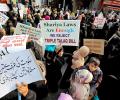
'The government know very well how to pass a bill in the Rajya Sabha with consensus.' 'They got consensus from Opposition parties on the 10 percent reservation for economically weaker sections.' 'In instant triple talaq, the BJP wanted to take sole credit.' 'They wanted to take credit and see that other parties suffer (political) loss.' 'Therefore, the bill got stuck.'

'The answer is no, the entire country's is.' 'So why such obsession with Delhi?' 'But the most powerful people in India live here: The prime minister, civil servants, Supreme Court judges, MPs, diplomats, dadas of the media...' 'If they can't deal with their own problem, what chance does the rest of the country have, with its foul air, dying rivers, frothing lakes, and crumbling mountains?' says Shekhar Gupta.

'Despite living in a free nation for so many years, if atrocities like rapes, public flogging, social boycotts are faced by Dalits, then conversion is the only option.'

'I don't think the state administration has shown the resolve to enter Muslim neighbourhoods and arrest offenders in the last decade.'

'If governments choose to spend our money on cow meat detection kits or hugely expensive statues, it is also a form of corruption.' 'A betrayal of our hopes and aspirations,' says Amit Mehra.
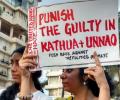
'They have no other agenda, but to perpetuate hate.' 'They have destroyed the economy and polity and they survive only on hate.' 'They think through hatred, they can mobilise the large chunk of Hindu votes.'

Journalist-turned-activist Teesta Setalvad in her new book 'Foot Soldier of the Constitution: A Memoir' has spoken of the rise of communalism and the aftermath of the '02 Godhra riots. In this interview with Rediff.com's Syed Firdaus Ashraf, she discusses her book, the cases against her and the state of secularism in the country.

'The majority community needs to accept that the Indian Muslim is peace loving, not communal and treat them accordingly.'

'The BJP will be wiped out in rural Gujarat.' 'In urban areas, its tally may come down from 55 of the 60 urban seats it won in 2012 to 35 to 40 seats this time.'

'If you put colour-coded internal security maps of India in May 2014 and now, the picture won't be flattering to Modi.' 'Failures on internal security are now piling up and can break Modi's momentum,' says Shekhar Gupta.

The party's most important electoral challenge lies in whether it can meet the aspirations of the youth who were drawn by the promise of gainful work.

'Public dissent is the highest public duty and I will continue to speak out,' says Harsh Mander.

'Mumbai's killings in January 1993 came at the tail end of two outbursts of vicious communal violence, whereas today, it's peacetime in a 'new India'.' 'At that time, the perpetrators warned onlookers to keep their mouths shut.' 'Today, the perpetrators take videos of their attacks, such is their confidence.' 'The mobs have succeeded in terrorising an entire community and indeed, all those dealing in the transport of cattle, whatever their religion,' says Jyoti Punwani.

'I am not a friend of anyone who wants to defend, justify and glorify any businessman, power drunk person or religious fanatics, fake activists, apologists of terrorists, appeasers of some, oppressors of others, pretending to be political leaders,' says Amit Mehra.

'General J S Aurora, the commander of the Indian forces in the East, asked General Sagat Singh to withdraw his troops who were on the move to Dacca -- but he refused.' 'He said, "Jaggi, over my dead body".' 'Therefore, I say the creator of Bangladesh was General Sagat Singh.'

The President has approved award of 398 gallantry and other defence decorations to armed forces personnel and others on the eve of the 68th Republic Day Celebrations.

'We cannot let this country be a place where the poor pay to shit.' 'That is inhuman and unacceptable.'

As the BJP snaps at its heels, can the Communists stay relevant in the electoral game?

'While I am personally pained at the raids on Dr Roy's home, I want to ask five questions of those crying themselves hoarse over the attack on the "freedom of the press",' says Sudhir Bisht.
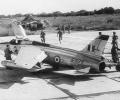
'As the IAF kicks off another round of myth-making -- launching a year-long commemoration of the 50th anniversary of the 1965 India-Pakistan war -- it is worth remembering how little there was to celebrate in those September days when the underdog PAF got the better of the IAF in raid after raid, dogfight after dogfight.'

'We have made no effort in recent years to build a national opinion on Kashmir amongst political parties.' 'At least we should speak as one country.' 'It has been a failure of our foreign policy that we have not been able to convince world opinion that something needs to be done about Pakistan.'

In insight into PNS Ghazi, the Pakistan Navy's prized submarine that now lies embedded in the Vizag seabed about 1.5 nautical miles from the breakwaters.

The issue of lynchings resonated in the Rajya Sabha; while in the Lok Sabha, the Opposition accused the government of not being sensitive towards farmers' issues.
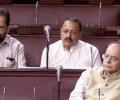
Most of the opposition parties blamed Rashtriya Swayamsevak Sangh-affiliates for the cow vigilantism.

Overseas consultant NNS Chandra offers advice on how to pick the right international education.

In an online chat with readers, chef Sanjeev Kapoor shares interesting anecdotes from his culinary journey.

'We were firing at Patton tanks that were moving towards India.' 'Fighter aircraft are the biggest menace for tanks because they come at great speed, attack from a height and their rockets are lethal.' 'The Hunter travels at 400, 420 knots. One knot is 1.6 times a km, so it was at a speed of 700, 800 km/hr.' 'You come at great speed and when you see the tanks, you pull up because attacks are always done in a dive.' 'You go up to 3,000 to 4,000 feet and then dive on to the target and let off your rockets...'

Three Indian Air Force officers captured as Prisoners of War by Pakistan during the '71 War made a daring escape from a Rawalpindi jail. M P Anil Kumar recounts that heroic story.
 © 2026 Rediff.com - Advertise with us - Disclaimer - Privacy Policy - Sitemap - Feedback - About us - Terms of use - Grievances